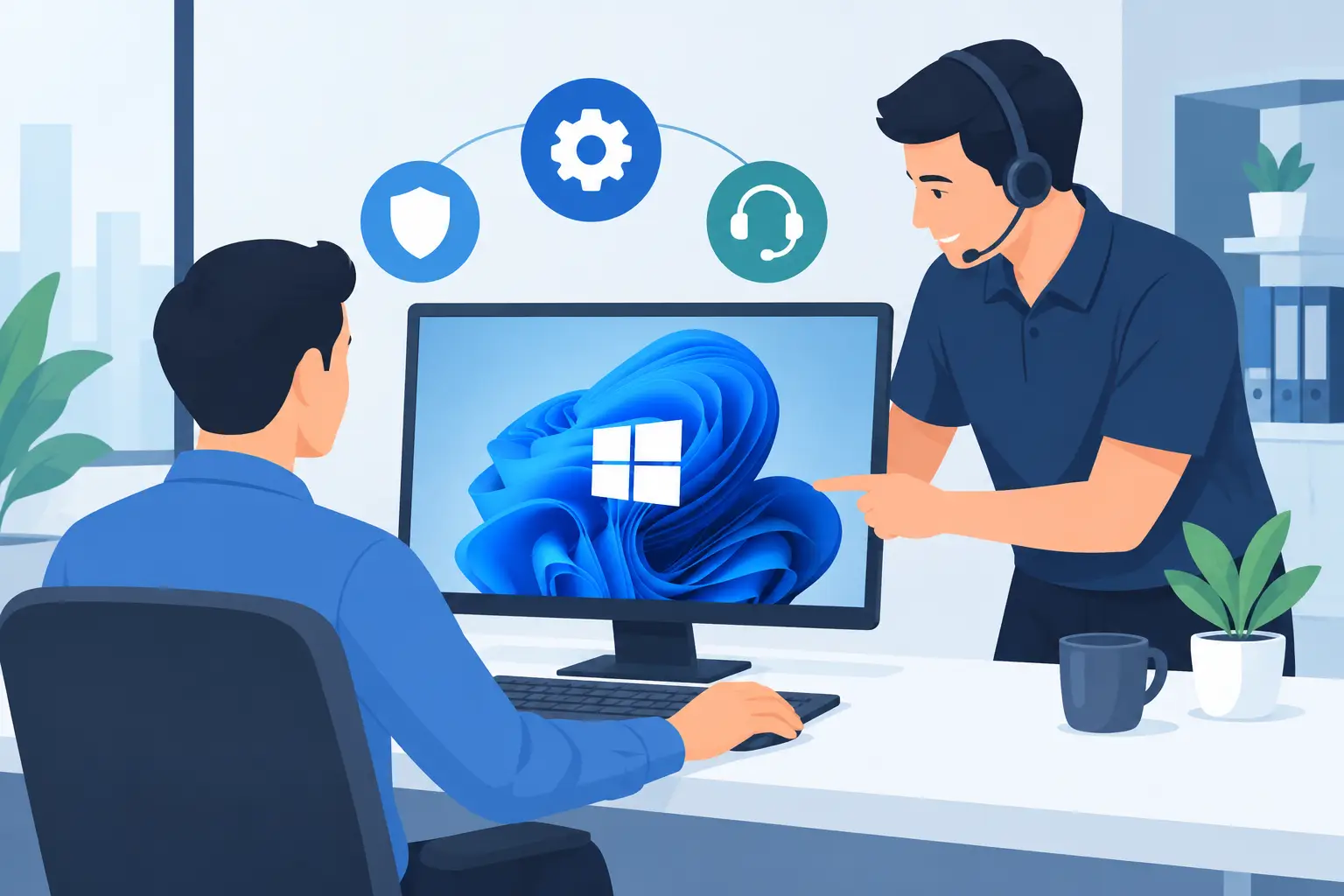
A locked Microsoft account at 8:12 a.m. can hold up an entire office. So can a laptop that will not connect to the shared drive, a printer that has stopped scanning, or a Windows update that changes a setting nobody expected. Windows workstation IT support is not just about repairing devices. It is about getting people back to work without making them spend half the morning trying fixes from a search result.
For small and mid-sized businesses, the standard is simple: staff should know where to ask, receive a useful answer quickly, and have a real technician available when the issue needs human hands. Anything less turns routine technology trouble into lost payroll, missed deadlines, and frustrated customers.
What Windows workstation IT support should cover
A workstation is the computer an employee uses to do their job every day. In a Windows-based office, that often means more than the PC itself. It includes the user's Microsoft account, email, files, printers, business applications, Wi-Fi access, security tools, and the permissions that determine what they can reach.
Good support treats these parts as connected. A person who cannot open a project folder may not have a file problem at all. Their password may have expired, a group permission may have changed, a VPN connection may be down, or a cloud synchronization app may be paused. Telling them to restart the computer is occasionally useful. It is not a support plan.
The everyday work usually includes password resets, account lockouts, software errors, printer and scanner problems, slow computers, failed updates, peripheral setup, and access requests. It should also cover less visible but equally important tasks: applying security patches, monitoring device health, protecting data, maintaining backups, and removing access when someone leaves the company.
The right scope depends on how your business operates. A construction office with shared field laptops has different needs from a law firm handling sensitive files or a manufacturer using specialized workstation software. Support should fit the work, not force every department into the same generic process.
Fast answers matter, but escalation matters more
Not every request needs a technician. If an employee needs to reconnect to Wi-Fi, find a printer, book a meeting room, or reset a password, a conversational assistant can handle the first response quickly. That keeps simple requests from sitting in a queue and gives employees help in plain language.
But automated answers have limits. A recurring Blue Screen error, a workstation that has lost network access, a suspicious sign-in alert, or a payroll application that will not launch needs investigation. The employee should not have to decide whether the issue is serious enough to escalate. The support system should recognize the signs and bring in a qualified person.
That is the difference between automation that merely deflects tickets and support that actually helps the business. Meet Gwen can handle common frontline requests, follow company-specific procedures, and pass work to a local technical team when the situation calls for it. Nothing outsourced, nothing off the shelf, and no guessing about who owns the problem.
The cost of treating workstation issues as interruptions
Most workstation problems look small when viewed one at a time. Five minutes here to find a missing file. Ten minutes there to reconnect a printer. Twenty minutes waiting for someone to approve a software install. Across a team, those delays become expensive quickly.
There is a second cost: the unofficial IT person. In many smaller organizations, a capable office manager, operations lead, or senior employee becomes the person everyone asks for help. They may be good at it, but it is not the work they were hired to do. Their own tasks get delayed, and the business becomes dependent on one person knowing where the workarounds are.
Reliable Windows support reduces both problems by creating a clear path for requests. Employees ask for help in ordinary terms. Routine fixes happen quickly. Recurring issues are recorded, investigated, and prevented where possible. Managers can see what is consuming time instead of hearing about problems only when they become urgent.
What a practical support process looks like
A useful support process begins before an employee has a problem. Each workstation should be known: who uses it, which version of Windows it runs, what key software is installed, whether it is encrypted, and whether it receives security updates. Without that basic picture, every issue starts with detective work.
When a request arrives, the first goal is to restore work safely. If an employee cannot access email because their account is locked, the solution may be straightforward. If they report a suspicious attachment or a request for a password reset they did not make, the priority changes from convenience to security.
After the immediate fix, look for patterns. A printer that repeatedly drops off the network needs more than another reconnection. A laptop that slows down every month may have a storage, update, or software conflict problem. Repeated requests for the same folder access may point to unclear onboarding procedures. Good support uses those patterns to remove future friction.
This is where a tailored service earns its value. A generic help desk can close a ticket. A team that understands your users, applications, and operating standards can improve the process that created the ticket in the first place.
Security cannot be separate from support
Employees often contact IT at the exact moment a security issue becomes visible: a strange multi-factor authentication prompt, a missing file, an unfamiliar browser extension, or a device that was left in a vehicle. The response must be fast and calm.
Windows workstation support should include clear steps for security incidents, patch management, endpoint protection, account access, and device recovery. It should also make secure behavior easier. If staff have to jump through confusing steps to get approved software or access a shared file, they will find a workaround. Workarounds are where avoidable risk starts.
There are trade-offs. Strict permissions can protect confidential data but slow down a fast-moving team if access requests take days. Broad access makes collaboration easier but can expose files unnecessarily. The practical answer is not one extreme or the other. It is to set permissions around real roles, review them regularly, and make legitimate requests simple to fulfill.
Questions to ask before choosing Windows workstation IT support
Start with the issues your staff actually report. Are password resets consuming the help desk? Are printers, remote access, or business software causing the most downtime? Do employees know where to get help after hours? Can someone explain what happens when an issue cannot be fixed remotely?
Ask how support handles your existing tools, not just Windows. Your team may depend on Microsoft 365, accounting software, estimating platforms, a document management system, shared drives, and line-of-business applications. If support treats each tool as someone else's responsibility, your staff will be pushed from vendor to vendor while work stops.
You should also ask what reporting you will receive. Useful reports show request volume, recurring issues, response times, unresolved risks, and opportunities to automate repetitive tasks. A monthly report full of technical acronyms is less helpful than a clear answer to: what is costing our people time, and what are we doing about it?
Finally, ask who you can call. For a business with real deadlines, human accountability is not an optional extra. A local team that knows your environment can make decisions, coordinate with vendors, and take responsibility when a problem is complicated.
Build support around the work your team already does
The best Windows workstation IT support is almost invisible on a normal day. Employees can sign in, access what they need, print documents, run required software, and get a direct answer when something goes wrong. The business sees fewer repeat problems and less time disappearing into manual handoffs.
Start with the everyday pain points your staff mention most often. Fix those well, document the process, and then look for the next repetitive task that can be handled faster. Technology should remove work from your team, not create another system they have to manage.